
Article body
Most restaurant accounts in Nepal post a photo of a dish, most days, forever. The follower count creeps up. The tables do not fill. The owner concludes social media does not work for restaurants, which is the wrong conclusion drawn from real evidence.
The problem is that daily food photography is one job, and a restaurant account has three. This is the content rhythm we set up for restaurants and cafés — what to post, when, and which of the three jobs each piece is doing. It assumes a single location with a real kitchen and a person who can give it three or four hours a week. Not an agency retainer's worth of time, and not a full-time content hire.
The only three jobs a restaurant account has
Everything worth posting does one of these. Most accounts do only the third, which is why they feel busy and change nothing.
Discovery. Reaching people who do not follow you and have never eaten with you. Almost entirely a Reels and TikTok job, because those are the only surfaces that route content to non-followers at any scale. A feed post reaches a fraction of the people who already follow you; it cannot bring you anyone new.
Decision. Someone has heard of you and is deciding tonight. They are looking for the menu, the price range, whether it is busy, whether it suits the occasion, and how to book. This is your profile, your highlights, your pinned posts, and your Google Business Profile — not your latest post.
Return. Reminding people who already like you that you exist this week. Stories, specials, the thing that is only on for three days. Low reach by design, high conversion.
Get the split roughly right and the account starts doing something. Post nothing but plated dishes and you are running Return forever, to an audience that stopped growing.
A weekly rhythm you can actually keep
The failure mode is not posting too little. It is posting eleven times in the week after a strategy meeting and nothing for the next three. Cadence you can sustain beats cadence you can describe.
| Day | What | Job | Realistic effort |
|---|---|---|---|
| Monday | Week's specials or set menu, to Stories | Return | 10 minutes |
| Tuesday | Reel: one dish being made, or the room filling | Discovery | 45 minutes |
| Thursday | Carousel: menu section, prices visible | Decision | 30 minutes |
| Friday | Reel or TikTok: the weekend reason to come | Discovery | 45 minutes |
| Saturday | Repost guest content to Stories | Return | 5 minutes |
| Any day | Reply to every comment, review and DM | Decision | 15 minutes daily |
Two Reels a week is the floor for discovery to do anything. Everything else on that list is maintenance, and maintenance is what most accounts are already doing exclusively.
The single highest-return habit on the list is the last one. An unanswered DM asking whether you take bookings is a table you lost while posting about tables.
What each format is actually for
| Format | Reaches non-followers | Best job | Shelf life | Effort |
|---|---|---|---|---|
| Reel / TikTok video | Yes, primarily | Discovery | Weeks to months | High |
| Carousel | Barely | Decision | Days | Medium |
| Single image post | Barely | Return | Hours | Low |
| Story | No | Return | 24 hours | Very low |
| Guest content you repost | Through their audience | Discovery and proof | Days | Almost none |
The last row is the one restaurants underuse most. A guest's video of your food reaches their friends, who live nearby and eat out, and it carries a credibility your own footage cannot buy. Make it easy: a legible handle on the menu and the door, and a habit of asking. You do not need a campaign for this.
The festival calendar is your content calendar
Nepal's demand for eating out is not evenly distributed across the year, and neither is the competition for attention. Dashain and Tihar, Nepali New Year, Teej, Holi and Losar each move restaurant traffic, and each one is planned by everyone else at the same time.
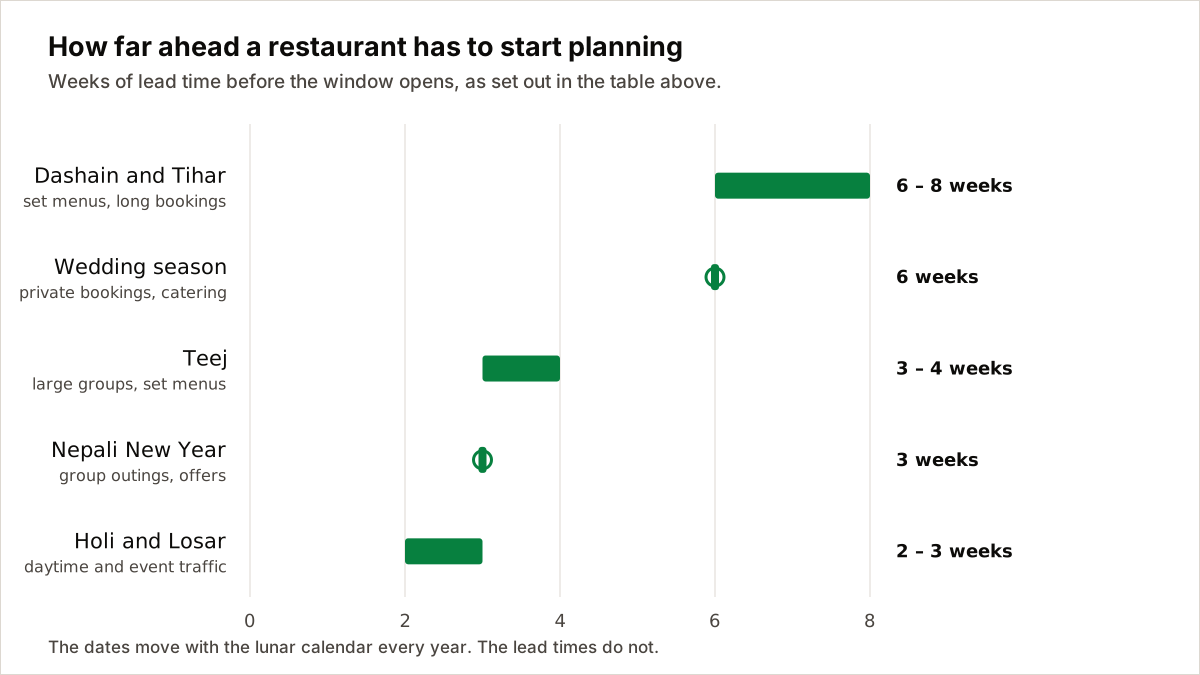
The specific dates shift with the lunar calendar every year, so check the current year's before you plan. What does not shift is the lead time:
| Window | What it changes for a restaurant | Start planning |
|---|---|---|
| Dashain and Tihar | Family groups, set menus, long bookings, staff shortages | 6 to 8 weeks ahead |
| Nepali New Year | Group outings, offers, a natural reason to post | 3 weeks ahead |
| Teej | Large all-women groups, specific menus | 3 to 4 weeks ahead |
| Holi and Losar | Daytime and event-driven traffic | 2 to 3 weeks ahead |
| Wedding season | Private bookings, catering enquiries, venue questions | 6 weeks ahead |
Two practical notes. First, the content you shoot for a festival has to be shot before the festival, when the kitchen is calmest — which is exactly when nobody feels like shooting festival content. Second, if you close or run reduced hours, post it repeatedly and pin it. The most damaging festival post a restaurant makes is the one it does not make, when a group arrives at a locked door.
Our corporate gifting calendar sets out the Dashain production dates in detail; the same squeeze applies to anything you need printed, from a set menu to a table card.
The reservation path has to exist before you drive traffic to it
This is where most restaurant social spending is wasted. The content works, someone taps through, and the path ends: a link to a homepage with no menu, a phone number nobody answers during service, or a Facebook page with the old hours.
Before increasing reach, make sure all of these are true:
- The menu is readable on a phone without pinching, and prices are on it
- Booking takes one tap: a form, a WhatsApp link, or a phone number that rings somewhere staffed
- Opening hours are correct in the same three places — Instagram, Facebook and Google
- Your location pin actually lands at your door, not on the main road
- Someone reads the inbox during the hours people book
That last list is a local search problem as much as a social one, and it is worth fixing first because it compounds. The 90-day local search system covers the profile side properly.
When the booking journey is the constraint, it needs building rather than posting around. For Aradhana Restaurant and Bar we built a bilingual reservation site with a lunch menu that rotates daily and a heat selector that carries the guest's choice into the booking — because the friction was in the path, not in the reach.
Paid social, kept small and kept on
Boosting a post that already did well is not a strategy, it is a reflex. It is also the most common way restaurant budgets disappear.
What works better is unglamorous: a small, always-on campaign with tight geographic targeting around your actual catchment, pointed at the one action you want. For most restaurants the catchment is far smaller than the radius they choose — people do not cross Kathmandu on a weeknight for dinner.
Two rules that hold regardless of budget. Run the same money continuously rather than in bursts, because a campaign that restarts every month never gets past its learning phase. And send paid traffic to the booking path, not to your profile, unless growing the following is genuinely the objective this quarter.
What to measure, and what to ignore
Follower count is the metric restaurants report and the one that predicts covers least well. It counts people who liked a video once, most of whom do not live near you.
Watch instead:
- Saves and shares — the signal that a post did decision work, not just entertainment
- Profile taps from a post — how many people the content made curious enough to look you up
- Direction requests and calls on your Google Business Profile, which move with real intent
- Link taps to the booking path, and how many of those complete
- Where new guests say they heard of you — ask, and write it down; it is the only measurement that connects the account to the till
None of that needs a dashboard. A note on the wall by the till, filled in for a month, will tell you more about which channel fills tables than any in-app analytics screen.
The five mistakes that cost the most
- Posting only plated food. It is Return content exclusively. The room, the people, the kitchen and the process are what travel.
- Hiding the prices. Price is the single most common reason someone decides against a restaurant, and refusing to show it does not remove the objection — it just moves the decision somewhere you cannot influence.
- Ignoring the inbox during service. Bookings arrive when people are hungry, which is exactly when nobody is watching the phone. Assign it.
- Restarting from zero every festival. Everything is planned as a one-off campaign, so nothing compounds and every season costs full price again.
- Buying followers or engagement. It corrupts the only audience signal you have, and the accounts that sell it are not delivering people who can walk to your door.
Where we come in
We run restaurant and café accounts as part of social media management — the weekly rhythm above, festival planning against a real calendar, guest content, and paid social kept small and continuous. It sits inside our wider hospitality work, which starts from where your bookings actually come from today rather than from a follower target.
If the booking path is the thing that is broken, that is website and app development work and we would rather fix it before spending anything on reach.
Running a restaurant and tired of posting into a void? Book a 30-minute call and we will look at your account, your profile and your booking path together, and tell you which of the three is costing you the most.
Quick answers
How often should a restaurant in Nepal post on social media?
Two short videos a week is the floor, because video is the only format that routes to people who do not already follow you. Everything else — stories, a menu carousel, reposting guest content — is maintenance that keeps existing followers warm. Five or six touches a week, most of them under fifteen minutes, beats eleven posts in one week followed by three quiet ones.
Should a restaurant in Nepal be on TikTok or Instagram?
Both, with the same video. They are the two surfaces that reach non-followers at any scale, and a Reel shot for one plays on the other with no extra production. Decide which to prioritise from where your own guests already are rather than from which platform you prefer.
Should a Nepali restaurant post in Nepali or English?
The test is not preference, it is the language your guests already use with you — read your reviews and your DMs and match them. Whichever you choose for captions, keep the practical details legible either way: menu, prices, hours, address and how to book.
Is boosting posts worth it for a restaurant?
Boosting whatever already performed is the most common way a restaurant budget disappears without leaving evidence. A small always-on campaign, targeted tightly around your real catchment and pointed at the booking path rather than your profile, does more with the same money — largely because a campaign that stops and restarts never gets past its learning phase.
Cite this article
GrowNexus Editorial Team (2026). "Restaurant Social Media in Nepal: The Content Rhythm That Fills Tables." GrowNexus, April 28, 2026. https://grow-nexus.com/insights/restaurant-social-nepal/


