
Every few months a founder asks us some version of the same question: should we train our own people to do this, or keep paying an agency? It is usually framed as a cost question. It is almost never actually a cost question.
The businesses that get this right do not choose one or the other. They work out which marketing capabilities decay if you outsource them, build those in-house, and buy the rest. This is how to make that call, and what to demand from a training programme once you have.
First, separate the three kinds of marketing work
Marketing is not one skill, and treating it as one is why so many training investments quietly fail. Split the work into three buckets before deciding anything.
Recurring execution. Scheduling posts, sending campaigns, updating listings, pulling weekly numbers, responding to comments and reviews. High frequency, moderate skill, enormous volume. Every hour an outside party spends on this is an hour billed at a rate that does not match the difficulty of the work.
Judgment. Deciding what to offer and to whom, what your positioning is, which market to enter, what a lead is worth, when to stop a campaign that is not working. Low frequency, very high stakes, and entirely dependent on context nobody outside your business fully has.
Specialist depth. Technical SEO, paid media at meaningful spend, conversion rate optimisation, creative direction, marketing automation architecture. Low frequency for any one business, but requiring pattern recognition across dozens of accounts to do well.
The rule that follows is simple. Build recurring execution and judgment in-house. Buy specialist depth.
Recurring execution is where outsourcing is most expensive per unit of value and easiest to teach. Judgment cannot be genuinely outsourced — an agency can inform it, but a partner who is not living with the consequences should not be making the call. Specialist depth is where a small in-house team will never accumulate enough repetitions to get good, and where a single wrong decision costs more than years of agency retainer.
The build-versus-buy test
For any specific capability, answer four questions honestly.
1. How often does this happen? Weekly or more, train it. Twice a year, buy it. Skills that are not exercised regularly decay to nothing within a quarter, and you will have paid for training that produces a certificate and no capability.
2. How fast does it change? Things that shift every few months — ad platform mechanics, algorithm behaviour, AI search — need someone tracking them across many accounts. Things that are stable — email fundamentals, brand consistency, review handling — are safe to own.
3. What does a mistake cost? A badly written social post costs an afternoon. A badly structured Google Ads account can burn a quarter's budget before anyone notices. Match the risk to the level of expertise you are putting behind it.
4. Is the person you would train going to still be here in eighteen months? This is the question people avoid. If your marketing executive is a fresh graduate on a starting salary in a market where trained digital marketers are actively recruited, you are funding your competitor's hiring pipeline unless you pair training with a retention plan. That does not mean do not train them. It means budget for it as a retention investment, structure it that way, and be honest about the arithmetic.
What a digital marketing course in Nepal should actually teach
The training market here has expanded quickly and quality varies enormously. Having hired from most of the well-known programmes and having taught our own for several years, these are the signals worth checking.
Red flags:
- The syllabus is a tool list. "Google Ads, Meta Ads, Canva, Mailchimp, SEMrush." Tools change; this teaches button locations, not marketing.
- No live account access. If learners never touch a real budget, a real analytics property, or a real client problem, they finish with theory and no judgment.
- Instructors who do not currently practise. Someone who ran campaigns three years ago is teaching a platform that no longer exists in that form.
- A guaranteed placement promise. It usually means the placement is with the training provider's own low-paid delivery team.
- Certificate-first marketing. If the sales pitch leads with the certificate rather than the capability, the certificate is the product.
What to look for instead:
| Look for | Why it matters |
|---|---|
| Live accounts and real budgets | Judgment only develops when a decision has consequences |
| Instructors running current client work | The platform mechanics they teach are the ones that exist today |
| Measurement taught before tactics | Someone who cannot read GA4 cannot evaluate their own work |
| Written strategy output, not just execution | The gap between an executor and a marketer is the ability to argue for a plan |
| Nepal-relevant context | Local payment rails, festival seasonality, Nepali-language search behaviour, and the platforms your customers actually use |
| Post-course support | Skills consolidate in the three months after training, not during it |
That last point on local context matters more than it sounds. A course built entirely on US case studies will not prepare anyone for how local search actually behaves in Kathmandu, how Dashain and Tihar reshape the demand curve, or why a Viber follow-up outperforms an email one.
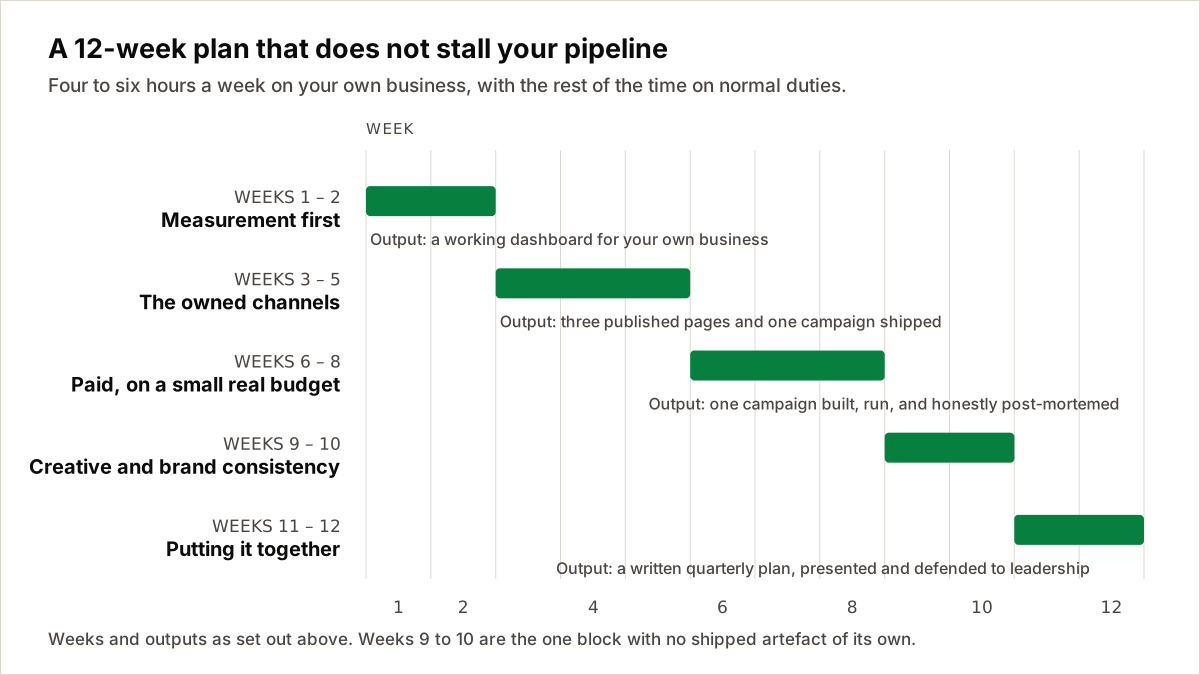
A 12-week plan that does not stall your pipeline
The most common failure mode is not bad training. It is pulling your only marketing person out of the business for a month, watching output stop, and concluding training was a distraction. Structure it so the work continues.
Weeks 1 to 2 — Measurement first. Analytics, conversion tracking, what a lead costs, what a customer is worth. Nothing else can be evaluated without this. Output: a working dashboard for your own business.
Weeks 3 to 5 — The owned channels. Website content, SEO fundamentals, email and direct messaging. These are the assets you keep. Output: three published pages and one campaign shipped.
Weeks 6 to 8 — Paid, on a small real budget. Structure, audiences, creative testing, reading a report and deciding what to change. Give them a genuinely small live budget rather than a simulation. Output: one campaign built, run, and honestly post-mortemed.
Weeks 9 to 10 — Creative and brand consistency. What good looks like, how to brief it, how to review it. Most in-house marketers are commissioning creative long before anyone teaches them how.
Weeks 11 to 12 — Putting it together. A written quarterly plan for the business, presented and defended to leadership. This is the assessment that matters. A certificate proves attendance; a plan you would actually fund proves capability.
Four to six hours a week, applied directly to your own business, with the remaining time on normal duties. Slower than an intensive bootcamp, and it produces something a bootcamp does not: work that shipped while the learning happened.
What training cannot fix
Be clear-eyed about the limits.
Training cannot fix a positioning problem. If prospects cannot tell why you rather than the cheaper option, no amount of channel skill compensates — you will simply execute a weak message more efficiently.
Training cannot create capacity. One trained person is still one person. If the honest constraint is hours rather than skill, training makes the bottleneck worse by raising expectations of what that person should produce.
Training cannot substitute for specialist depth at scale. When ad spend reaches the point where a two percent efficiency difference exceeds the cost of expert help, buy the expertise. That threshold arrives earlier than most founders expect.
How to know it worked
Set these before the first session, not after the last one.
- Output volume. Campaigns, pages, and posts shipped per month, compared with the three months before.
- Cycle time. How long from idea to live. This usually improves before anything else does.
- Dependency. The share of monthly work still requiring outside help. This is the number the whole investment is meant to move.
- Cost per lead and cost per customer. Slower to move, and the one leadership will actually ask about. Give it two quarters before drawing conclusions.
If dependency has not fallen after six months, the training did not take — and the honest response is to look at whether the work you tried to internalise belonged in the "buy" column all along.
Where agency support still wins
Even with a strong in-house team, a few things are worth keeping outside: technical SEO and site migrations, paid media above meaningful spend, high-stakes creative, and a periodic outside audit — because internal teams stop being able to see their own blind spots after about a year.
The healthiest arrangement we see is an in-house team owning execution and judgment, with an outside partner on specialist work and a standing review rhythm. The in-house team gets faster and cheaper over time. The partner keeps the technical floor from dropping. Neither is trying to do the other's job.
We run practitioner-led training built on exactly this model — taught by the people running live client accounts, on your own business rather than a case study. If you want help working out which side of the build-versus-buy line each of your capabilities falls on, book a 30-minute call and we will map it with you.


