
Most local SEO advice was written for cities where every business sits at a numbered address on a named street, where customers have left reviews for a decade, and where Google's map data is dense and self-correcting. Kathmandu is none of those things. That is the problem, and it is also the opportunity: the bar in the local pack here is low enough that a service business doing the basics properly can outrank competitors who have been trading twice as long.
This is the 90-day system we run for service businesses in Kathmandu, Lalitpur and Bhaktapur. It assumes you sell something with a considered purchase cycle to customers within roughly an hour's travel: a clinic, a law or accounting firm, a repair service, a salon, a training centre, a restaurant, a real estate office.
Why local search in Kathmandu behaves differently
Three structural differences change what you should prioritise.
Addresses are landmarks, not street numbers
Very few Kathmandu businesses can be found by street address alone. People navigate by landmark and by ward: "opposite Bhatbhateni, Naxal", "behind the Pulchowk campus gate". Google's local ranking still leans heavily on proximity and on a confident, verified pin location. When your pin is dropped 300 metres off, or your address string is written in a format nobody searches with, you lose visibility you never see reported anywhere.
The practical consequence: your pin placement and your address formatting are ranking work, not admin work. Treat them accordingly.
Review volume is low, so a few reviews move a lot
In competitive Western markets a local business may need hundreds of reviews to be credible. In most Kathmandu service categories the top three results in the local pack have double-digit review counts, and plenty have fewer than twenty. That means the gap between you and the leader is often ten or fifteen genuine reviews, not a thousand. A review system that produces two or three a week closes that gap inside a quarter.
Search language is mixed and inconsistent
Nepali customers search in English, in romanized Nepali, and in Devanagari, often within the same session, and they mix them: "best momo near me", "dentist Baneshwor price", "ghar jagga Kathmandu". You cannot guess your way to this. Pull the actual queries from Search Console and from Google Business Profile before you write a single page, because the phrasing your customers use is frequently not the phrasing you use internally.
Days 1 to 30: fix the foundation
Nothing in this phase is glamorous and all of it is load-bearing. Do not skip ahead.
Claim, verify and complete Google Business Profile
An unverified or partially completed profile cannot rank, no matter how good your website is. Complete every field, including the ones that feel optional: opening hours for every day, holiday hours, the products or services list, attributes, and the business description.
Verification in Nepal is usually by video or postcard and can take a couple of weeks. Start it on day one so it is not the thing blocking day forty.
Make the NAP decision once, then never deviate
NAP is Name, Address, Phone. Google builds confidence in a business by seeing the same three strings repeated identically across the web. Inconsistency is the single most common technical cause of weak local rankings we find in audits here.
Decide, in writing:
- The exact legal-and-trading name. Not "GrowNexus Pvt. Ltd. | Digital Marketing Agency". Just the name on your signage. Keyword-stuffing your business name is a suspension risk and competitors do report it.
- One address string, character for character. Including how you write the ward, the tole, and whether you use "Kathmandu 44600" or no postcode at all.
- One primary phone number, in one format, with the country code written the same way every time.
Then put that block in a shared document and use it everywhere: website footer, contact page, Facebook, Instagram bio, directories, invoices, email signatures.
Choose the primary category deliberately
The primary category is the strongest single ranking lever in Google Business Profile, and most businesses pick it carelessly. Search the query you actually want to win, open the top three local results, and look at what primary category they use. If all three use a category you do not, that is your answer. Add secondary categories for genuine adjacent services, but resist listing everything you have ever done — a diluted category set ranks for nothing in particular.
Set service areas honestly
If customers come to you, set a physical address and leave the service area radius modest. If you travel to customers, list the specific municipalities you genuinely serve rather than drawing a circle around the whole valley. Overstated service areas do not expand your reach; they dilute relevance signals in the places you can actually win.
Days 31 to 60: build proof
Foundation gets you eligible. Proof gets you chosen.
Make review generation a process, not a plea
Sporadic requests produce sporadic reviews. Systems produce compounding ones. What works:
- Identify the moment of maximum satisfaction in your delivery — not the invoice, the moment the customer's problem is visibly solved.
- Ask in person at that moment, then follow with a message containing the direct review link. A verbal ask followed by a link converts several times better than a link alone.
- Send the link by Viber or WhatsApp, which most Nepali customers read, rather than email, which many will not open.
- Reply to every review within 48 hours, positive and negative. Responses are visible to prospects and demonstrate that the business is attended to.
- Never buy reviews. Filtered, removed, and in the worst case a suspended profile. The short-term gain is not worth the risk.
Aim for a steady two to three a week rather than a burst of thirty. A sudden spike from a profile with no history looks exactly like what it usually is.
Upload photos on a schedule
Photos are a freshness and engagement signal, and in categories where customers are choosing between near-identical listings they are often the deciding factor. Post the interior, the exterior from the street as a customer approaches it, the team, and the work itself. Two or three uploads a month, geotagged by uploading from a phone on site, beats a single upload of fifty stock images.
Build the citations that actually exist in Nepal
Ignore the bulk citation packages sold by offshore agencies; most of those directories carry no weight and some are actively spammy. Focus on:
- Your own website, with the NAP block in the footer sitewide
- Facebook and Instagram business profiles
- Apple Maps and Bing Places
- LinkedIn company page
- Genuine Nepal-specific directories and marketplaces relevant to your category — Hamrobazar for classifieds-driven categories, Foodmandu and similar aggregators for restaurants, established local chamber and trade association listings
- Any professional body you legitimately belong to
Twelve accurate, relevant citations outperform two hundred scraped ones.
Fix the website signals
The profile does not work alone. On your site:
- A real location or contact page with the NAP block, an embedded Google map, and directions written the way a local would give them — by landmark.
- LocalBusiness structured data on that page, with the same NAP strings, opening hours, and geo coordinates as the profile.
- A page for each service you want to rank for, not one page listing all of them. If a customer would search it separately, it deserves its own page.
- Page speed that survives a 4G connection on a mid-range Android phone, which is how most of your traffic will arrive.
We cover the technical side of this in more depth on our SEO and AI search service page, and measured how much of it a competitive Nepal market has actually done in our answer engine optimization benchmark.
Days 61 to 90: compound it
Use Google Posts and Q&A
Posts appear directly in your profile and expire after a week, which makes them a weekly habit rather than a project. Offers, events, new services, festival hours.
The Q&A section is more valuable and almost universally ignored. You are allowed to ask and answer your own questions. Seed it with the questions your front desk answers every day: parking, pricing range, languages spoken, whether you accept eSewa or Khalti, whether appointments are needed. Every answer you write is one less reason for a prospect to leave and check a competitor.
Build location and service landing pages
Once the core is stable, expand deliberately. A page targeting "service plus location" should contain genuinely location-specific content — local landmarks, local pricing context, local case examples — not a template with the place name swapped. Google has been demoting templated location pages for years, and users bounce off them immediately.
Do not build fifty of these. Build three or four for the areas where you genuinely do the most business and can write something true.
Plan for the festival calendar
Nepal's demand curve is not flat and it does not follow the Gregorian calendar. Dashain and Tihar reshape almost every consumer category between roughly September and November. Wedding season drives its own spike. The Nepali fiscal year ending in Ashar drives a scramble in professional services. New Year in Baisakh drives another.
Practical application: publish your festival hours in Google Business Profile before the holiday, not during it. Run Posts and offers in the two to three weeks before peak, not on the day. And plan any content you want ranking for a seasonal query at least eight weeks ahead, because it will not rank the week you publish it.
The 90-day plan in one table
| Phase | Focus | The one thing that matters most |
|---|---|---|
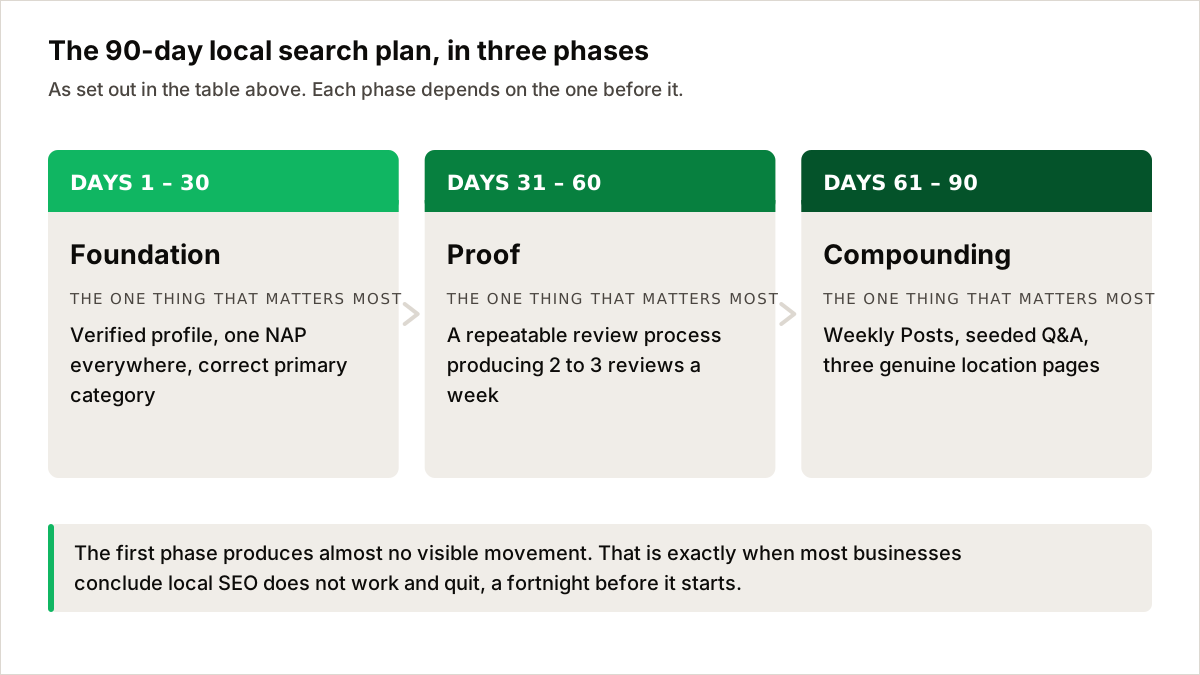
| Days 1 to 30 | Foundation | Verified profile, one NAP everywhere, correct primary category |
| Days 31 to 60 | Proof | A repeatable review process producing 2 to 3 reviews a week |
| Days 61 to 90 | Compounding | Weekly Posts, seeded Q&A, three genuine location pages |
How to measure whether it worked
Vanity rank checks from your own laptop are useless — your results are personalised and proximity-weighted. Measure this instead:
- Google Business Profile performance: searches that showed your profile, and the split between discovery searches and direct searches. Growth in discovery searches means new people are finding you; that is the number local SEO exists to move.
- Profile actions: calls, direction requests, website clicks. Direction requests are the strongest purchase intent signal a local business gets.
- Search Console: impressions and average position for your location-modified queries specifically, filtered from everything else.
- GA4: organic sessions landing on your location and service pages, and the conversion events attached to them.
Set a baseline before you start. Without one, ninety days of work becomes an argument about whether anything changed.
The five mistakes that cost the most
- Keyword-stuffing the business name. Effective until it is reported, then a suspension.
- Multiple profiles for one location, usually created accidentally over the years by different staff. Find and merge duplicates before doing anything else.
- A virtual office or a home address you cannot prove. Google is aggressive about this and reinstatement is slow.
- Ignoring negative reviews. An unanswered one-star review is more damaging than the rating itself, because prospects read the silence as confirmation.
- Stopping at day 30. The foundation phase produces almost no visible movement, which is exactly when most businesses conclude local SEO does not work and quit a fortnight before it starts.
What good looks like at day 90
You will not have won every query. What you should have is a verified, complete profile with consistent NAP everywhere, a review count that is climbing on a predictable curve, a website that tells Google the same story as the profile, and a measurement baseline that shows you which direction things are moving.
That is the platform. Rankings follow it — usually somewhere between month three and month six, and then they hold, because a foundation built this way does not decay when you stop paying attention for a fortnight.
If you want a second set of eyes on where your local visibility is leaking, book a free 30-minute call and we will run through your profile and your Search Console data together.


