
Two questions decide every corporate gifting programme in Nepal, and almost nobody publishes an answer to either: how much should we spend per person, and when do we actually need to order?
Search for either and you get product catalogues. The most useful results are a Facebook group thread asking about price ranges and a Reddit thread asking what to give employees — which tells you the questions are real and the answers are not written down anywhere.
So here they are, with the 2026 dates worked backwards into deadlines you can put in a calendar.
The 2026 calendar, and the dates that actually bind you
Dashain 2026 runs from Ghatasthapana on 11 October to Vijaya Dashami (Tika) on 21 October. Tihar follows in early November, with Laxmi Puja on 8 November.
Those are not your deadlines. Your deadlines sit weeks earlier, for a reason most first-time buyers discover too late: your staff leave the valley before Tika. People travel to their home districts for Dashain, often a week ahead. A gift that arrives on the 20th reaches an empty office.
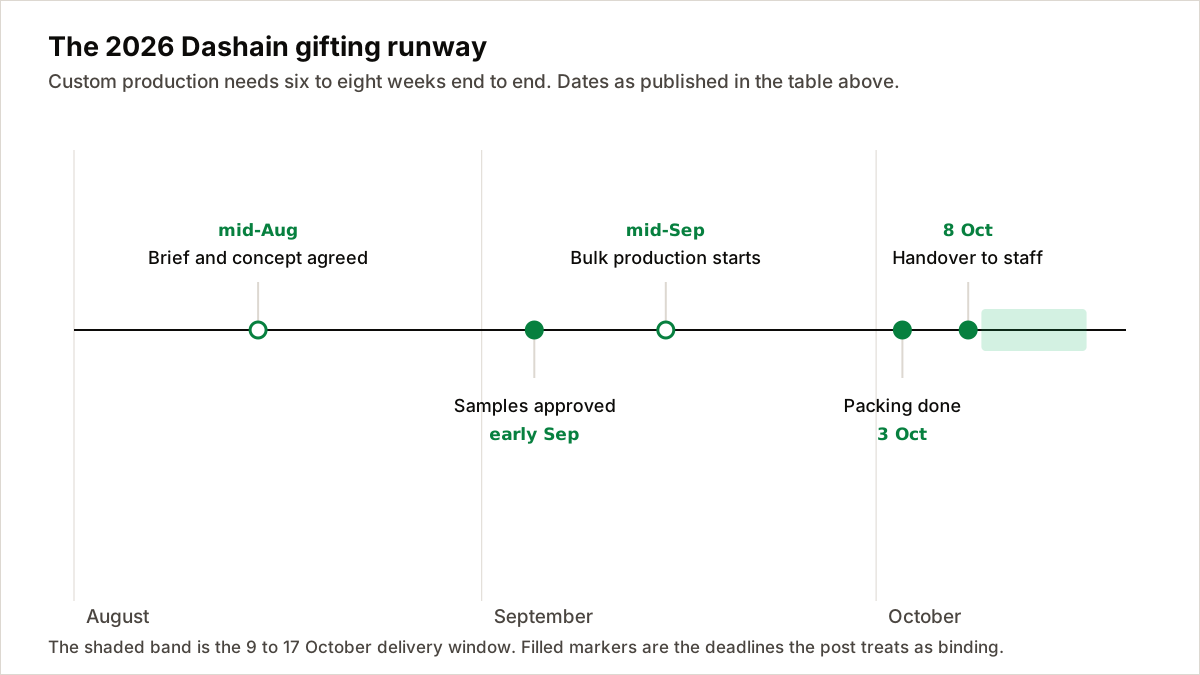
Working backwards from Dashain 2026:
| What | When | Why this date |
|---|---|---|
| Brief and concept agreed | by mid-August | Custom production needs 6 to 8 weeks end to end |
| Samples approved | by early September | Never approve a bulk run without holding the sample |
| Bulk production starts | by mid-September | Vendors are booked solid through late September |
| Packing and assembly done | by 3 October | Assembly is always slower than the quote implies |
| Handover to staff | by 8 October | Before people travel — this is the real deadline |
| Client delivery | 9 to 17 October | Ahead of Tika, while offices are still staffed |
If you are reading this in late September, custom-branded production is already off the table for Dashain. That does not mean you do nothing — see the section on Tihar below, which is the window most companies forget they still have.
What corporate gifting actually costs in Nepal
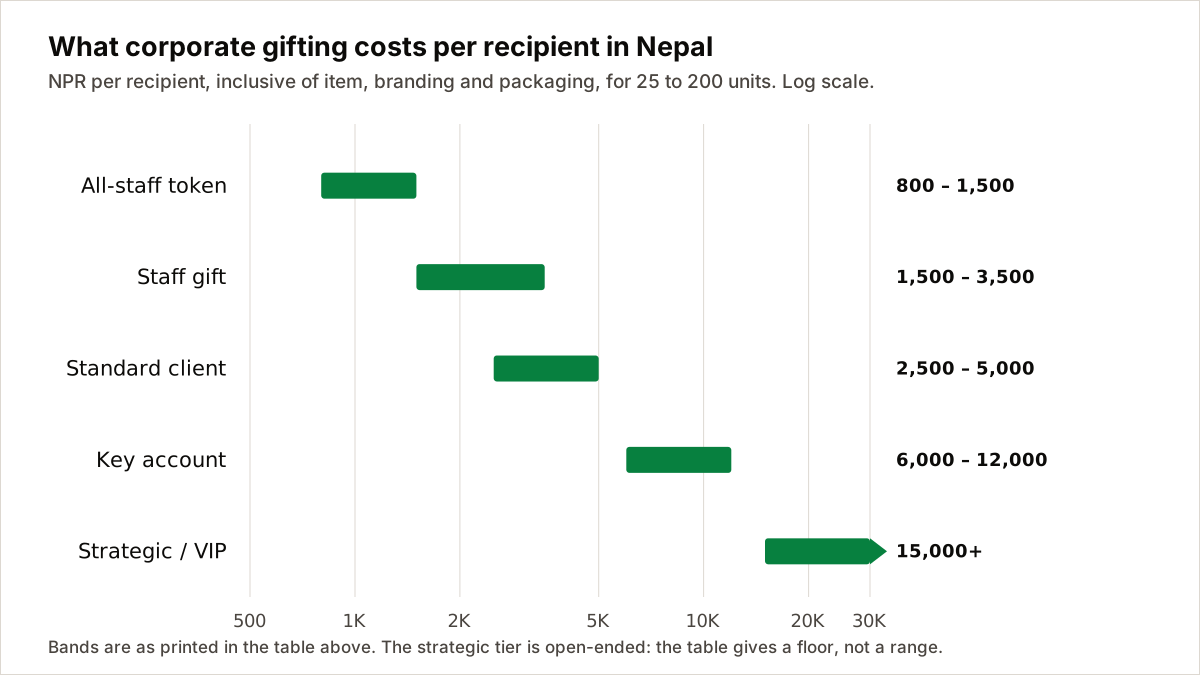
This is the number people ask for privately and nobody prints. These are the per-recipient bands we budget to, inclusive of the item, branding and packaging, for orders in the 25 to 200 unit range.
| Tier | Per recipient | What that realistically buys |
|---|---|---|
| All-staff token | NPR 800 – 1,500 | A quality single item: a good notebook, a decent bottle, sweets in branded packaging |
| Staff gift | NPR 1,500 – 3,500 | A small curated set — two or three items with real packaging |
| Standard client | NPR 2,500 – 5,000 | A curated hamper, or one genuinely premium branded object |
| Key account | NPR 6,000 – 12,000 | A considered, personal gift with proper presentation |
| Strategic / VIP | NPR 15,000+ | Individually chosen, individually packed, hand-delivered |
Three things to know about those numbers:
Unit cost falls sharply with quantity, but not below the minimum order. Most custom-branded items in Nepal carry a minimum of 25 to 50 pieces. Ordering 15 of something usually costs close to what 50 would.
Packaging is 15 to 25 percent of the budget, and it is the part people cut first. It is also the part the recipient sees before anything else. A NPR 3,000 gift in a poor box reads cheaper than a NPR 2,000 gift in a good one.
Branding and design is a real line item. If nobody has budgeted for artwork, someone will end up stretching a logo over a mug at the last minute, and the result will be visible for years.
Custom branded, or curated off the shelf?
This single decision drives your entire timeline.
Custom branded — apparel, printed diaries, engraved drinkware, anything carrying your mark. Six to eight weeks. Higher perceived value, works as year-round brand presence, and you control quality. Off the table after mid-September for a Dashain delivery. If you go this route, our branded merchandise specification guide covers decoration methods, artwork requirements and what to check before approving a bulk run.
Curated off the shelf — dry fruits, honey, local confectionery, ceramics, plants, assembled into a branded box with a printed card. Two to three weeks. Lower minimum quantities, far more forgiving on timing, and frankly it is what most Nepali recipients prefer at Dashain anyway.
The pragmatic answer for most companies is both: custom for staff and key accounts where the brand presence earns its keep, curated for the broader client list where speed and taste matter more than logo placement.
What gets kept, and what goes in a drawer
After enough of these programmes the pattern is consistent.
Kept and used: good bottles and flasks, quality notebooks and diaries, tote and laptop bags, ceramics, anything edible and local, plants, warm layers before winter.
Used once, then drawer: branded mugs (everyone already has six), plastic pens, keyrings, mousepads, desk calendars, anything with a print that peels.
The test is simple and worth applying honestly to your own shortlist: would you use this if it did not have a logo on it? If not, you are not buying a gift, you are buying a disposal cost with your name printed on it.
The second test is placement. A subtle mark on a genuinely good object reads as confidence. A large logo across the front of a cheap object reads as advertising, and people do not display advertising in their homes.
Staff gifts and client gifts are different problems
They get lumped into one budget line and they should not be.
Staff gifts are about fairness and timing. Everyone compares. Vary the gift by seniority and you will hear about it. Pick one good thing at one level, give it to everyone, and hand it over before people travel. If you have field staff or multiple branches, plan the distribution logistics before you plan the gift — that is the part that fails.
Client gifts are about relevance and restraint. A tiered list is not just acceptable, it is expected. What matters is that the gift looks chosen rather than distributed. A handwritten card with a modest gift outperforms an expensive gift with a printed compliments slip almost every time.
One constraint worth checking before you plan either: many organisations have gift policies with value caps, particularly INGOs, banks, listed companies and anything donor-funded. Sending something above a recipient's declarable limit creates an awkward problem for them, not a good impression. If in doubt, ask their office manager — nobody has ever been offended by that question.
Five mistakes that cost the most
- Starting in the last week of September. You will pay a rush premium, take whatever stock exists, and skip the sample. All three show.
- Approving a bulk run without holding the sample. Print adhesion, embroidery density, colour accuracy and material feel cannot be judged from a photo. Every disaster we have been called in to fix started here.
- No delivery plan. Gifts sitting in a store room on the 19th of October have failed. Kathmandu traffic in the week before Tika is its own logistical event.
- One list, no tiers, on the client side. Spending the same on a first-year account and a five-year account wastes money at one end and sends the wrong signal at the other.
- Treating Tihar as an afterthought. Which brings us to the window most companies leave on the table.
Tihar is the second window, and it is wide open
Almost all corporate gifting effort in Nepal goes into Dashain. Tihar, three weeks later, gets a card at best.
That is an opportunity rather than a rule. Laxmi Puja on 8 November 2026 is explicitly a festival of prosperity and business relationships — arguably a more natural fit for a B2B gift than Dashain is. Offices are open. Nobody has travelled. Your gift arrives in a quiet inbox rather than competing with fifteen others.
And the timing rescues anyone who reads this too late for Dashain: a Tihar programme briefed in September still has a comfortable custom-production runway, and a curated one briefed in mid-October is entirely achievable.
If you can only do one properly this year, doing Tihar well beats doing Dashain in a rush.
A decision process that fits on one page
- Set the total budget and the head count before looking at a single product. Divide, and you have your per-recipient band. Most bad gifting starts with browsing.
- Split the list into staff, standard clients and key accounts. Three tiers is enough. Five is admin you will regret.
- Pick custom or curated per tier, using the lead time above as the constraint, not the preference.
- Approve a physical sample. Always. No exceptions, including when the vendor is a friend.
- Plan the handover before the production. Who hands it to whom, where, and on which date — written down, with the pre-travel deadline in it.
Where we come in
We run corporate gifting and branded merchandise as a managed service: concept, design, sourcing from vetted suppliers, sample approval, quality inspection and delivery coordination. We do not hold stock, which means we have no reason to push you toward whatever is sitting in a warehouse — we specify what suits the brief and the deadline.
If you are planning Dashain or Tihar 2026 and want the calendar and budget worked out against your actual head count, book a 30-minute call. Bring your list size and your total budget; that is enough to leave with a plan.

