
Almost every branded merchandise disaster we get called in to fix has the same cause, and it is not a bad vendor. It is a bad specification. Someone sent a logo as a JPEG, approved a photo of a sample instead of the sample, and never wrote down where the print should sit or how big it should be. Two hundred units later, the print is off-centre, the colour is wrong, and there is nothing in writing to argue with.
Specifying merchandise properly is a couple of hours of work. This is what goes into it.
Choose the decoration method before you choose the product
This is the decision people make last and should make first, because it constrains everything else — which products are possible, what your artwork has to look like, your minimum quantity, and your unit cost.
| Method | Best for | Realistic minimum | Colour handling | Durability |
|---|---|---|---|---|
| Screen printing | Cotton apparel, tote bags, volume runs | 50+ | Setup cost per colour; 1 to 3 colours ideal | Excellent |
| Embroidery | Polos, caps, jackets, uniforms | 25+ | Thread colours, no gradients | Excellent, outlasts the garment |
| DTF transfer | Full-colour apparel, small runs | 10+ | Unlimited colours, photographic | Good, but a film hand-feel |
| Sublimation | Polyester sportswear, mugs, mousepads | 25+ | Unlimited, edge to edge | Permanent — dyed into the fibre |
| Pad printing | Pens, small curved items | 100+ | 1 to 2 colours | Good on hard goods |
| Laser engraving | Metal, wood, bamboo, glass | 25+ | No colour — tonal only | Permanent |
| UV printing | Flat rigid items, tech accessories | 25+ | Full colour | Good, can chip on edges |
Two constraints inside that table cause most of the surprises:
Sublimation only works on polyester, or on items coated for it. If someone promises you a full-colour, edge-to-edge print on a 100 percent cotton t-shirt, they are not sublimating it. And sublimation cannot print white — white in your design means the fabric showing through, so it needs a white or light garment.
Embroidery cannot do fine detail. Below roughly 4 to 5 mm, letters fill in and become unreadable, and thin strokes disappear entirely. If your logo has small type or hairline elements, you need a simplified embroidery version of it — which is artwork you should own, not something a vendor improvises at production time.
The artwork rules that decide whether it works
Get these right and most quality problems never happen.
Supply vector, not raster. AI, EPS, PDF or SVG. A PNG or JPEG pulled off a website is roughly 200 pixels wide and will look exactly that soft when it is printed 100 mm across. If vector genuinely does not exist, that is a signal your brand needs a proper asset set before it needs merchandise.
Specify colours as Pantone, not "the green from our website". Screens, threads and inks are different systems, and a hex value means nothing to a screen printer mixing ink. Pick the Pantone references once, write them into your brand guidelines, and hand the same numbers to every vendor forever.
Own a single-colour version of your logo. Engraving, embossing and one-colour screen printing all need it. If you have not made one, someone at the vendor will, and they will make choices you would not.
Set a minimum size and clear space. Below a certain size your mark stops being legible. Write down that size and the clear space around it, and half of all bad placements disappear.
Embroidery needs digitising, and it is a real step. Your artwork is converted into a stitch file, and the quality of that conversion determines the result. Ask to see a stitch-out — a sample of the digitised design on the actual fabric — before the run. Ask who owns the digitised file, too. It is yours by rights and it saves the setup cost on every reorder.
Fabric and product selection
For apparel, GSM is the number to ask for. It is the fabric weight in grams per square metre and it is the single best proxy for whether something feels cheap.
- 140 to 150 GSM: thin. Fine for a one-day event, not for a gift.
- 160 to 180 GSM: the standard range for a good t-shirt.
- 190 to 220 GSM: premium tees and most polos. This is where staff uniforms should sit.
Also settle the composition. 100 percent cotton breathes and prints beautifully by screen but shrinks and creases. Polyester blends hold shape, dry fast, take sublimation, and suit anything sporty. For Kathmandu, where you are dressing people across a wide temperature range, a 60/40 or 65/35 blend is usually the pragmatic answer for uniforms.
For hard goods, ask one question before anything else: is this made here or imported? Apparel, bags and printed paper goods are largely produced domestically. Drinkware, tech accessories and most novelty items are imported and sit in a Kathmandu importer's stock. That difference decides your lead time and how much of the design you can actually change.
The sample stage, and what to check
Never approve a photograph. Hold the sample. Then run through this:
- Colour against the physical Pantone chip, in daylight, not under office lighting.
- Placement, measured. From the collar seam, from the centre. Not eyeballed.
- Wash test for apparel — one wash at the temperature people will actually use, then look at the print edges and the colour.
- Rub test for prints on hard goods. A thumbnail along the edge tells you a lot in two seconds.
- Size grading. A logo scaled identically across S to XXL looks wrong on both ends. Confirm the print scales with the garment.
- The full size run, if you are ordering apparel. Nepali size labelling is inconsistent between vendors, and an "L" from one supplier is a different garment from another's.
- The packaging. It is part of the product, and it is what the recipient meets first.
Write the approval down. A signed sample and a one-page spec is what turns a disagreement about the bulk run into a five-minute conversation instead of a loss.
Working with suppliers in Nepal
Lead times. Locally produced apparel with a straightforward decoration runs two to four weeks in a normal month. Imported hard goods depend entirely on whether the item is in stock in Kathmandu — if it is, days; if it needs bringing in, six weeks or more, and customs is not predictable enough to promise a date on.
The festival capacity crunch is real. In the six weeks before Dashain, every print and embroidery shop in the valley is at capacity. Prices firm up, lead times stretch, and the sample stage is the thing that gets skipped. Anything seasonal needs to be briefed well ahead of that — the Dashain and Tihar ordering calendar has the dates worked backwards.
Payment is usually advance or part-advance. Budget for that in your cash flow, and get the spec agreed before money moves, because that is the point at which your leverage is highest.
Minimum order quantities are softer than they look on hard goods and firmer than they look on apparel. An importer sitting on stock will often break a carton. A garment unit setting up a screen will not run 15 pieces at a sensible price, because the setup cost does not care how many you print.
What it costs
Indicative unit costs including a single-position decoration, for orders in the 50 to 200 range:
| Item | Indicative unit cost |
|---|---|
| Round-neck t-shirt, 160–180 GSM, screen print | NPR 650 – 1,100 |
| Polo shirt, 200+ GSM, embroidered logo | NPR 1,200 – 2,200 |
| Cotton tote bag, screen print | NPR 350 – 700 |
| Hardcover notebook, branded | NPR 450 – 900 |
| Stainless steel bottle, laser engraved | NPR 900 – 1,800 |
| Ceramic mug, sublimated | NPR 350 – 650 |
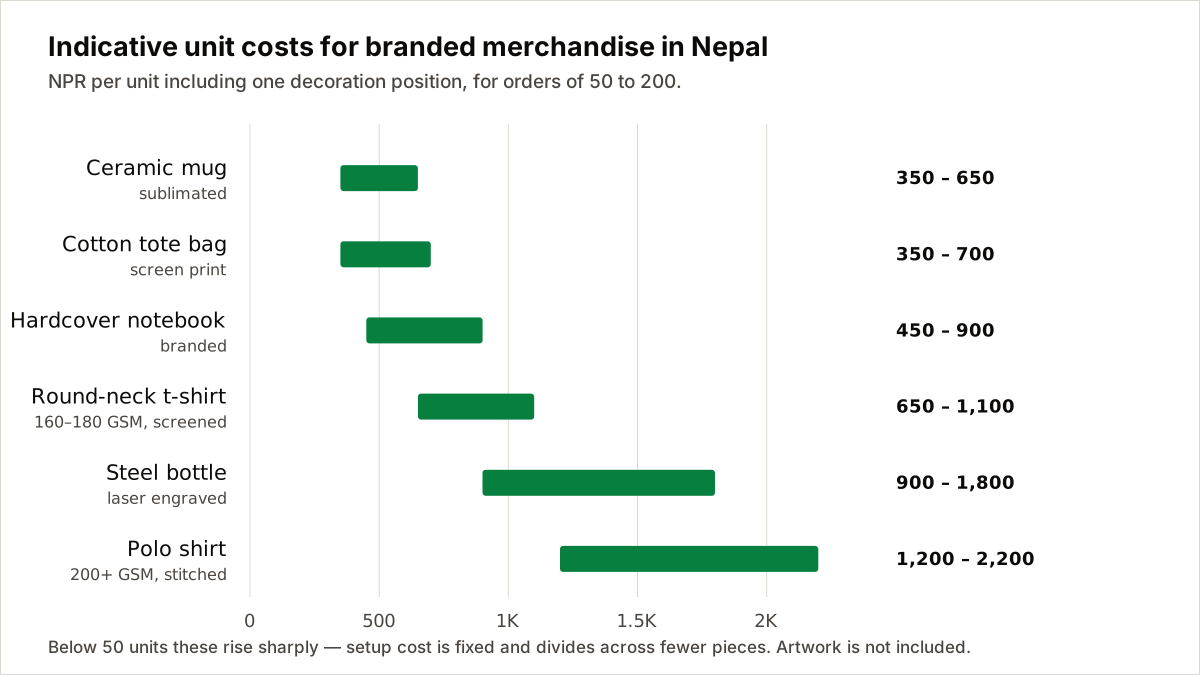
Below 50 units, expect these to rise sharply — setup costs are fixed and get divided across fewer pieces. Design and artwork preparation sits outside these numbers; budget for it as a real line item rather than assuming a vendor will do it for free, because what you get for free is what free is worth.
The specification sheet
This is the actual deliverable, and the whole point of the exercise. One page per item, containing:
- Product, exact model or reference, colour, and size breakdown
- Fabric composition and GSM, for apparel
- Decoration method and position, with measurements from a fixed seam
- Print or stitch size, and the artwork file name and format
- Pantone references for every colour
- Quantity, and the packaging requirement
- Sample approval date and who signed it
- Delivery date and delivery address
If a vendor gets the run wrong and you have this, the remake is their cost. If you do not have it, the argument is your word against theirs, and you will usually pay twice.
Where we come in
We run corporate gifting and branded merchandise as a managed service — concept, artwork preparation, vendor sourcing, sample approval and quality inspection before bulk. We do not hold stock, so we have no reason to steer you toward whatever is sitting in a warehouse. If you would rather run it yourself, take the specification sheet above and use it; it is the part that actually protects you.
Planning a merchandise run or a uniform programme? Book a 30-minute call with your quantities and a rough budget, and you will leave with a spec you can send to vendors.

