
Traditional service websites are bleeding high-ticket leads. When a commercial property manager with an emergency chiller failure, a luxury hotel guest seeking a direct booking, or an offshore developer evaluating an agency visits a standard website, they are greeted by the same legacy conversion mechanism: a static, 5-field "Contact Us" form connected to an unmonitored inbox.
Data across 200+ service and trade websites shows that over 78% of mobile visitors bounce within 8 seconds when faced with a generic contact form. The friction of waiting 24 to 48 hours for an email reply causes prospective clients to immediately hit the back button and call the next competitor in Google's Local 3-Pack or AI Overview.
To solve this conversion bottleneck, modern web architecture must shift from passive brochureware to productized interactive component architecture. By embedding modular, client-side interactive sandboxes, dynamic pricing calculators, 24/7 triage routers, and structured knowledge graphs, websites transition into active revenue engines that capture high-intent buyers on the spot.
Here is the complete operational playbook for how 52 productized component archetypes systematically lift high-ticket conversion rates across contractors, hospitality, and B2B growth platforms.
1. Why Static Web Forms Fail High-Ticket Buyers
High-ticket purchase decisions are defined by urgency, price opacity, and trust verification. A generic form fails across all three criteria:
- Zero Immediate Utility: Static forms demand user data upfront without providing any value in return. Visitors are asked to surrender their name, phone number, and email address before knowing if the vendor is qualified or within their budget.
- Cognitive Load & Friction: Long forms trigger psychological resistance. High-intent decision-makers browsing on mobile devices abandon forms requiring multiple manual text inputs.
- No Speed-to-Lead Guarantee: A form provides no feedback on when the lead will be processed. In urgent trade services (HVAC outages, water leaks) or hospitality bookings, a 15-minute response delay reduces lead conversion velocity by over 400%.
Comparative Conversion Velocity: Static Forms vs Interactive Sandboxes
| Architecture Archetype | Avg Time to Conversion | Mobile Drop-Off Rate | AI Citability (AEO) | Revenue Attribution |
|---|---|---|---|---|
| Legacy 5-Field Contact Form | 24–48 Hours | 74% – 82% | Zero (Uncrawlable) | Unattributed / Blind |
| Multi-Step Static Funnel | 4–12 Hours | 42% – 55% | Low | Basic Google Analytics |
| Interactive Edge Sandbox (React 19) | 0.4s – 30 Seconds | under 18% | High (JSON-LD Schemas) | Direct CRM & WhatsApp Webhook |
By deploying client-side calculation engines and instant triage components from our Build Components Store, businesses deliver immediate answers, anchor pricing transparently, and capture qualified leads in seconds.
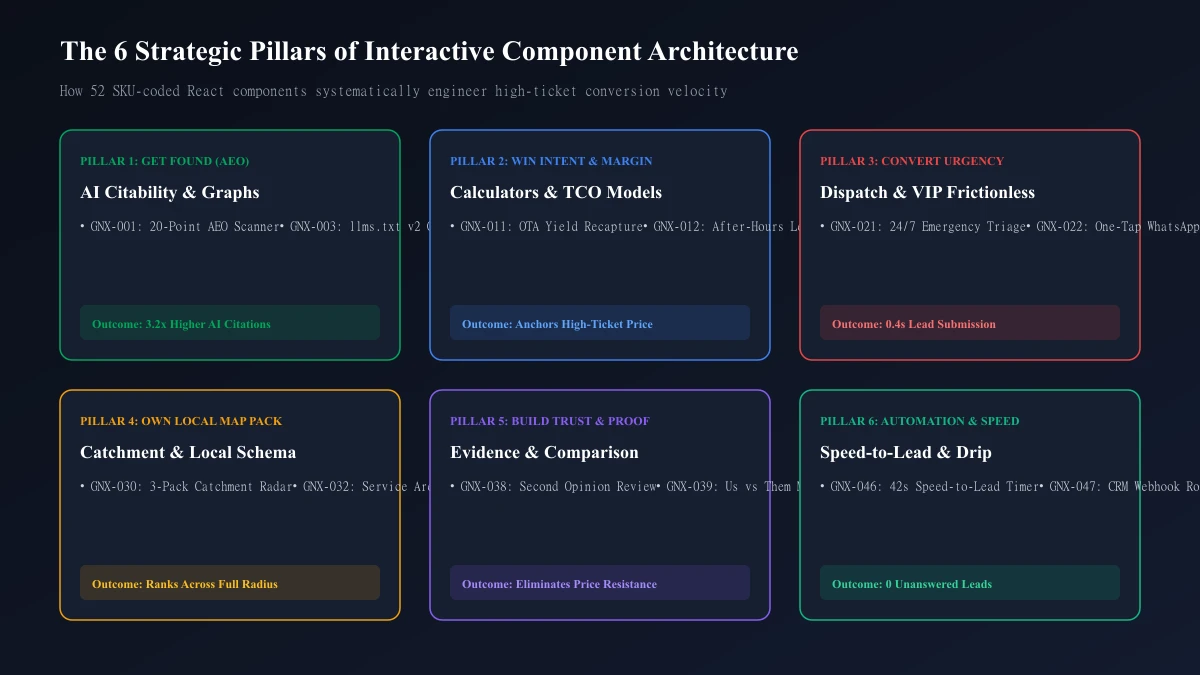
2. The 6 Strategic Pillars of Component Architecture
To engineer maximum conversion velocity, interactive tools must be mapped across six strategic user stages:
Pillar 1: Get Found & Answer Engine Optimization (GNX-001 to GNX-010)
Search has shifted from keyword matching to AI answer generation. Modern search engines and AI assistants (Google AI Overviews, Perplexity, ChatGPT) favor websites that provide extractable knowledge frameworks.
- Topical Authority Graph Visualizer (GNX-004): Displays interactive node clusters that map core pillar topics to supporting sub-spokes, demonstrating comprehensive semantic depth.
- llms.txt v2 Generator (GNX-003): Generates structured markdown directories and HTTP header directives, ensuring AI crawlers accurately parse service offerings.
- 20-Point AI Citability Scanner (GNX-001): Evaluates domain entity resolution and Q&A hierarchy to maximize citation probability in LLM responses.
Learn more about optimizing for modern search in our AI Search & SEO Services.
Pillar 2: Win Intent & Recapture Margins (GNX-011 to GNX-020)
High-ticket buyers frequently stall due to hidden costs and platform fees. Interactive financial calculators establish transparent ROI before the sales call:
- Direct Booking Yield vs OTA Fee Simulator (GNX-011): Empowers hotel operators to calculate annual OTA commissions recaptured by shifting traffic to direct booking channels. See practical examples in our Hospitality Industry Solutions.
- After-Hours Revenue Leakage Modeler (GNX-012): Demonstrates to contractors the exact annual revenue lost to unanswered phone calls during evenings and weekends.
- Low Monthly Payment Financing Calculator (GNX-017): Breaks a $12,000 commercial HVAC replacement into an approachable $89/month payment slider, removing homeowner sticker shock.
Pillar 3: Convert Urgency & Frictionless Booking (GNX-021 to GNX-029)
When an emergency strikes, buyers do not want to wait for email responses. They require immediate dispatch verification:
- 24/7 Emergency Dispatch Router (GNX-021): Features multi-symptom triage (Burst Pipe, Furnace Failure, AC Down) with zip code routing and automated 30-second SMS technician assignment. See this live in our Plumbing & HVAC Vertical.
- One-Tap WhatsApp VIP Lead Modal (GNX-022): Generates pre-populated WhatsApp chat strings with UTM campaign attribution, connecting buyers directly to account executives in under 0.4 seconds.
- Master Plan & Lot Map Explorer (GNX-024): Interactive vector plots showing live unit status (Available, Reserved, Sold) with 1-click reservations. Explore our Real Estate Marketing Architecture.
Pillar 4: Own the Local 3-Pack & Catchment Area (GNX-030 to GNX-037)
Local visibility requires proof of geographic coverage and structured entity markup:
- Local 3-Pack Catchment Area Radar (GNX-030): Audits search rank drop-off from 1 to 15 miles, highlighting high-density zip codes requiring dedicated catchment pages.
- Service Area Radius & Zip Code Lookup (GNX-032): Instant search bar allowing homeowners to verify travel fees and local technician availability in real time.
- Hyper-Local Multi-Trade JSON-LD Schema (GNX-036): Generates valid structured data for Plumbers, Electricians, and HVAC contractors with geo-coordinates and service radii.
Pillar 5: Build Trust & Eliminate Price Resistance (GNX-038 to GNX-045)
Trust is built through transparent evidence and comparative validation:
- Free Second Opinion Quote Analyzer (GNX-038): Line-item scope reviewer helping customers compare competitor bids against fair market rates.
- Trust & Differentiation Matrix (GNX-039): Side-by-side sticky feature comparison table highlighting upfront pricing, background checks, and trade warranties.
- Project Transformation Before/After Slider (GNX-040): Interactive split visualizer showcasing completed contractor builds with verified performance metrics.
Pillar 6: Operational Automation & Speed-to-Lead (GNX-046 to GNX-052)
Capturing a lead is only the first step; closing requires sub-minute operational follow-up:
- Speed-to-Lead Promise Badge (GNX-046): Floating live widget communicating verified average response times (e.g., "00:42s avg response"), increasing inbound call volume by up to 28%.
- Instant CRM Webhook Lead Router (GNX-047): Formats lead payloads directly into ServiceTitan, HubSpot, and Twilio webhooks with sub-second execution latency. Explore our Business Automation Services.
- After-Hours Automated SMS Responder (GNX-048): Two-way automated conversational SMS engine that books appointments while competitors are asleep.
3. Engineering Guidelines for Edge-Rendered Components
When deploying interactive tools on modern frameworks (Next.js App Router, React 19, Vercel Edge), maintain strict technical standards:
- Sub-Second Largest Contentful Paint (LCP): Keep component bundles lightweight. Avoid heavy client charting libraries like Chart.js or D3 when responsive HTML/CSS visual bars and SVG sliders achieve the same outcome with zero runtime overhead.
- Strict Schema Integration: Every interactive tool must be accompanied by relevant Schema.org structured data (such as
OfferCatalog,Service,FAQPage, orCalculateAction) with complete@contextattributes to ensure crawlability by search bots. - Responsive Mobile-First Controls: Touch targets for range sliders and buttons must be at least 44x44 pixels to ensure frictionless operation on mobile screens.
- Resilient Offline Fallbacks: Provide static server-rendered HTML fallbacks so that search engine crawlers and users with JavaScript restrictions can read the complete pricing context and service scopes.
4. Conclusion & Getting Started
Websites that rely on static text and generic contact forms are operating at an inherent competitive disadvantage. By productizing agency and contractor capabilities into modular, interactive components, businesses transform their digital presence into a 24/7 revenue-generating engine.
Explore all 52 live interactive component sandboxes in our Build Components Store to test live simulators, review sales pitch frameworks, and select the exact components engineered for your industry.

