
Hiring a digital marketing agency is one of the most consequential decisions a business makes. Get it right, and your customer acquisition costs fall, search authority compounds, and pipeline revenue grows month over month. Get it wrong, and you spend twelve months paying thousands of dollars for generic social media graphics, bot impressions, and monthly reports that show green charts while your actual sales flatline.
The digital marketing landscape in 2026 is crowded with hundreds of agencies promising guaranteed number-one Google rankings, viral social campaigns, and proprietary AI growth systems. In practice, most agency failures come down to a single structural issue: the people who pitch you during the sales call never touch your account after the contract is signed.
This guide provides a systematic framework for evaluating digital marketing agencies in Nepal and international markets. It details the exact questions to ask, the red flags that signal low-value retainer mills, and how to structure engagement terms that protect your capital and tie agency fees to pipeline outcomes.
The Core Problem: The Agency Retainer Trap
Most traditional agency relationships break down because the business incentives of the agency are directly opposed to the growth needs of the client.
| Agency Model | Typical Operational Reality | Client Outcome |
|---|---|---|
| Traditional Retainer Mill | High overhead, sales-heavy. Accounts pitched by senior directors are handed off to junior coordinators managing 15 to 20 clients simultaneously. | Templated work, slow communication, generic reports tracking vanity impressions rather than sales. |
| Outsourcing Arbitrage | Agency acts as an expensive middleman, white-labeling technical SEO, coding, or ad operations to unvetted subcontractors with high markup. | Broken website code, disconnected strategies, and zero accountability when campaigns fail. |
| Senior In-House Pod | Lean, practitioner-led agency where senior specialists (SEO, CRO, Paid Media, Engineering) execute the work directly without account managers. | Custom architecture, sub-second technical execution, transparent data attribution, and rapid revenue impact. |
When evaluating prospective agencies, your first goal is determining which of these three models the agency actually runs behind its marketing facade.
5 Critical Questions to Ask Before Signing Any Agency Contract
Before committing to a monthly retainer, put these five specific questions to the agency leadership during your discovery meeting.
1. Who specifically will execute the technical and strategic work on our account?
In traditional agencies, account managers act as buffers between you and junior execution staff. When you ask why your organic traffic dropped or why your cost per acquisition spiked on Meta Ads, the account manager has to schedule an internal meeting to find out.
What to look for: Look for agencies that operate on a direct pod model. You should have direct communication with the actual technical SEO specialist, paid media buyer, and conversion rate engineer working on your campaigns.
2. How do you attribute revenue to your marketing activities?
If an agency defines success using impressions, reach, followers, or raw click volume, walk away. In 2026, advertising platforms make it easy to buy cheap traffic that never converts.
What to look for: The agency must demonstrate how they connect Google Analytics 4 (GA4), Google Search Console, and your CRM (HubSpot, Salesforce, ServiceTitan, or custom databases) using closed-loop conversion tracking. They should report on cost per qualified lead (SQL), customer acquisition cost (CAC), and return on ad spend (ROAS) rather than vanity engagement.
3. What is your technical web development stack?
Marketing cannot succeed on a slow, brittle website. If an agency suggests building your digital presence on bloated legacy themes with 40 third-party plugins, your site will suffer from high Core Web Vitals latency and poor mobile conversion rates.
What to look for: Modern agencies build on headless, high-performance architectures (such as Next.js, React, Tailwind CSS, and headless CMS platforms like Sanity). Fast sites earn higher Google search rankings and convert mobile traffic at twice the rate of slow WordPress themes.
4. Do we retain 100% ownership of all ad accounts, tracking pixels, and code?
A common predatory practice among low-tier agencies is hosting client campaigns inside agency-owned ad accounts or holding domain assets hostage when contracts end.
What to look for: Demand written confirmation that all Google Ads accounts, Meta Business Managers, Google Tag Manager containers, Google Analytics properties, and repository code remain in your corporate name from day one. If you part ways, you retain every ounce of historical campaign data and digital equity.
5. What does the first 90 days look like?
Beware of agencies that promise instant results in week two. Sustainable digital growth requires structured discovery, technical auditing, foundational fixes, and disciplined campaign scaling.
What to look for: A clear, documented four-phase roadmap:
- Days 1 to 14: Audit & Discovery: Technical site health, conversion tracking audit, competitor gap analysis, and entity search footprint.
- Days 15 to 30: Foundation & Fixes: Resolving tracking errors, Core Web Vitals remediation, on-page SEO canonicalization, and audience architecture.
- Days 31 to 60: Strategic Launch: Deploying high-intent search assets, productized conversion components, and structured paid media campaigns.
- Days 61 to 90: Optimization & Scale: Weekly sprint iterations, CRO multivariate testing, and budget reallocation toward proven revenue channels.
Red Flags vs. Green Flags: The Agency Evaluation Scorecard
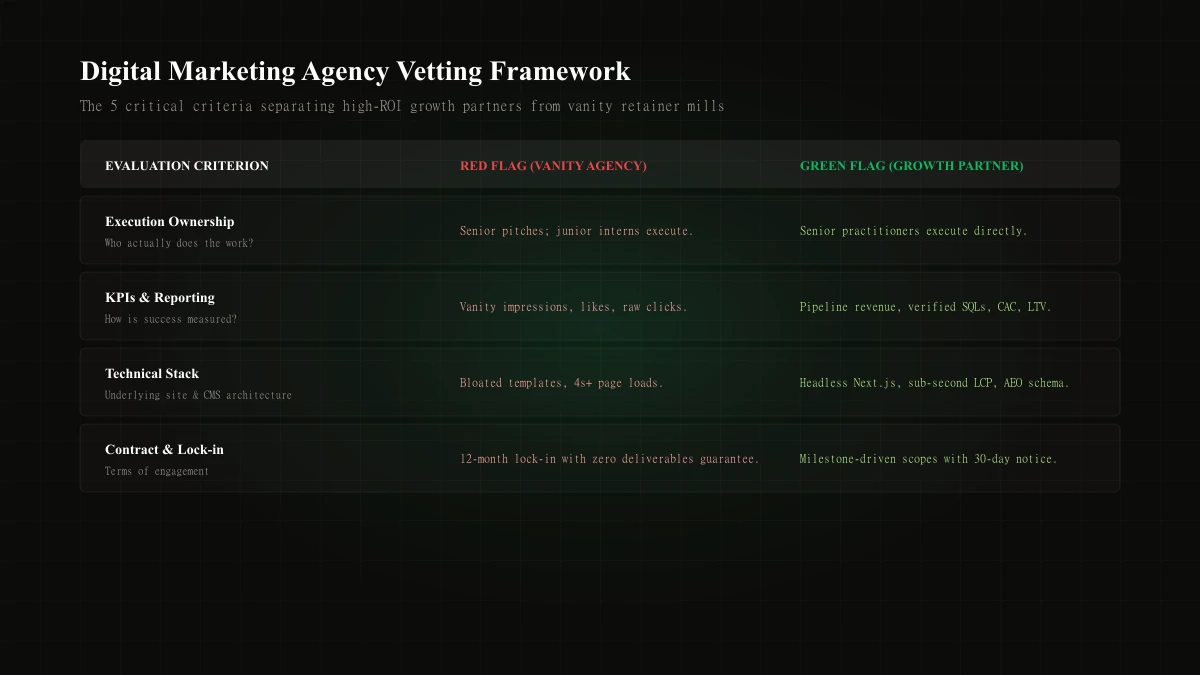
Use this comparison matrix to grade prospective agency partners during your review process:
| Evaluation Area | Red Flags (Walk Away) | Green Flags (Hire) |
|---|---|---|
| Sales Process | Guaranteed #1 rankings in 30 days; rigid one-size-fits-all packages. | Deep diagnostic discovery; honest appraisal of timeline and competitive landscape. |
| Team Structure | Account managers handle all client calls; execution team is hidden. | Direct access to senior specialists (SEO, Paid Media, Creative, Development). |
| Reporting & KPIs | Monthly PDF decks showing vanity impressions, reach, and page likes. | Real-time live dashboards tracking pipeline revenue, qualified leads, and CAC. |
| Search Engine Strategy | Keyword stuffing, unvetted PBN links, and mass-generated unformatted AI text. | Entity-based search optimization, answer engine optimization (AEO), and llms.txt discovery maps. |
| Contract Terms | 12-month lock-in contracts with aggressive early-termination penalties. | 90-day initial sprints transitioning to month-to-month retainers with 30-day notice. |
Pricing Models: What Digital Marketing Actually Costs
Agency pricing generally falls into three structures. Understanding these helps you budget realistically and avoid hidden fees:
1. Fixed Monthly Retainer (Standard Growth Engagements)
- Price Range: NPR 45,000 to NPR 250,000 / month in Nepal; $1,500 to $6,000 / month internationally.
- Best For: Ongoing multi-channel growth encompassing technical SEO, content engineering, paid media management, and weekly conversion rate optimization.
- What to Watch: Ensure the scope defines specific deliverable volumes (e.g., published technical pillar assets, sprint hours, optimization cycles) rather than vague advisory hours.
2. Project-Based Sprint (Foundational Upgrades)
- Price Range: NPR 120,000 to NPR 500,000+ ($1,500 to $8,000+).
- Best For: Headless website redesigns, complete technical SEO overhauls, conversion rate optimization redesigns, or migrating to interactive web components.
- What to Watch: Milestones must be tied to objective completion criteria (e.g., passing Core Web Vitals with LCP under 1.2s, verified GA4 conversion tracking, complete CMS handover).
3. Fractional CMO / Strategic Growth Leadership
- Price Range: NPR 80,000 to NPR 180,000 / month ($2,000 to $5,000 / month).
- Best For: Mid-market enterprises and funded startups needing executive-level go-to-market strategy, revenue architecture, and direct oversight of in-house marketing pods.
How GrowNexus Delivers Marketing Execution
At GrowNexus, we engineered our agency model around the exact operational principles we recommend to our clients:
- 100% In-House Senior Pod: When you work with GrowNexus, your campaigns are strategized and executed directly by our senior team: Arman Ahamed (SEO, CRO, and AI Search Architecture), Bibesh Shrestha (Senior Paid Media & Analytics), and Gaurav Dhakal (Creative Direction & Brand Identity). Zero subcontracting, zero junior hand-offs.
- Performance-First Headless Technology: We build marketing websites on modern Next.js and Tailwind infrastructure with sub-second page loads, structured JSON-LD schemas, and native AEO optimization.
- Closed-Loop Revenue Attribution: We connect every campaign to actual revenue metrics, giving you clear visibility into which channels generate profitable returns.
If you are currently evaluating agency proposals or looking to audit your existing marketing retainers, we invite you to request our Free Second Opinion Scope Review. We will review your current technical site health, analytics setup, and ad spend efficiency to provide an unvarnished assessment of where your growth opportunities lie.
Frequently Asked Questions
How long does it take for a digital marketing agency to generate results?
For paid search and social ads, qualified leads can begin flowing within the first 14 to 30 days once campaign tracking and landing pages are validated. For organic SEO, Answer Engine Optimization (AEO), and domain authority building, sustainable ranking momentum typically requires 60 to 90 days of consistent technical publication and authority optimization.
Should we hire an in-house marketing manager or an agency?
Hiring a single in-house employee costs NPR 40,000 to NPR 100,000+ per month plus equipment and benefits, yet one person rarely possesses deep expertise across technical coding, SEO architecture, paid media buying, copywriting, and graphic design. An agency provides a complete multi-disciplinary senior pod for the same or lower cost.
What is Answer Engine Optimization (AEO) and why should an agency offer it?
Answer Engine Optimization (AEO) structures your website content and data entities so that generative AI engines like ChatGPT, Google AI Overviews, Apple Intelligence, and Perplexity cite and recommend your brand. In 2026, over 25% of commercial search queries trigger AI answers before traditional organic links.
How do we get out of a bad agency contract?
Review your service level agreement (SLA) for material breach clauses, including failure to deliver agreed-upon assets, lack of access to tracking accounts, or missing monthly reporting deliverables. Most reputable agency contracts include a standard 30-day written notice termination clause.


